Paper Plate, Proper Pizza: Britain's Best Slices for Eating on Your Feet
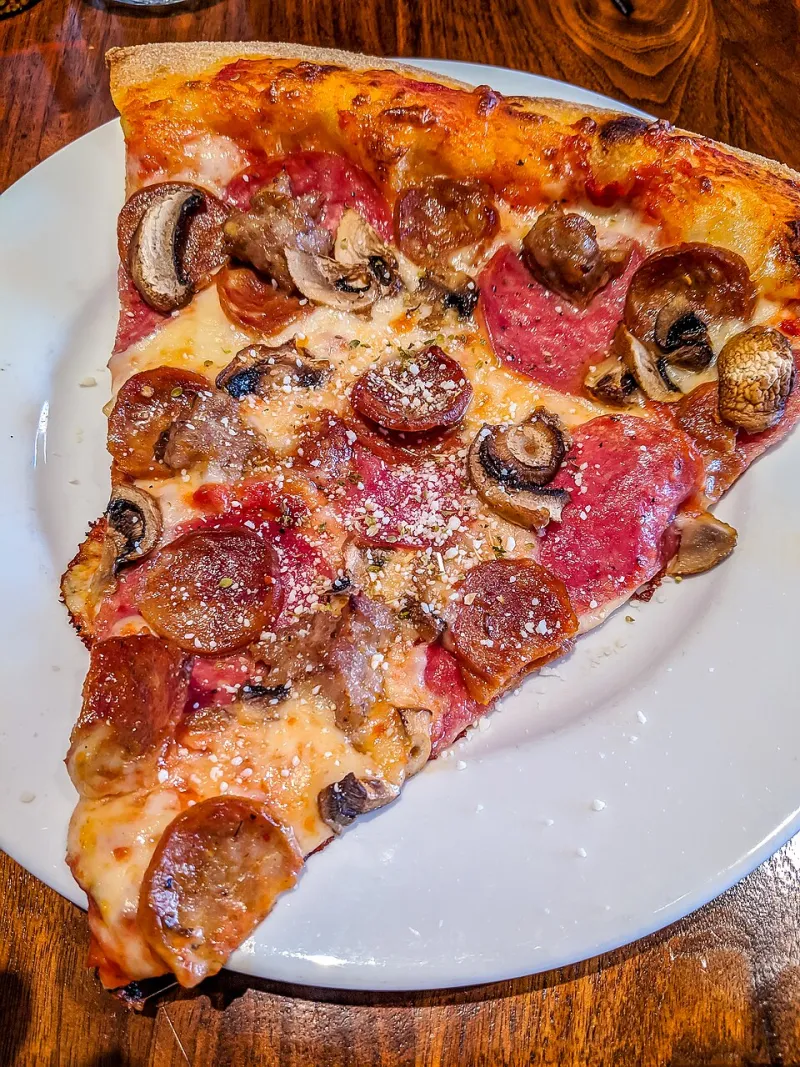
Photo: Dale Cruse from San Francisco, CA, USA, CC BY 2.0, via Wikimedia Commons
There is a particular kind of pizza that only tastes right when you're standing up. It comes on a paper plate that's slightly too floppy. There's a fold in the middle where the base has given up and accepted its fate. You're holding it at chest height, angled away from your coat, and there is a queue of strangers directly behind you who will judge you if it collapses.
It is, on its day, the best way to eat pizza in Britain. Not the fanciest, not the most romantic, not the one you'd book for an anniversary. But the most honest, the cheapest and — crucially — the one that never makes you feel like you've overstayed your welcome.
Why the slice counter is the great British pizza format
A whole pizza is a commitment. It demands a table, a dining companion, an hour and a half of your life, and a decision about pudding. A slice demands three minutes, a fiver and nothing else. It slots into a shopping trip, a lunch break, a train delay, a wet Tuesday.
Britain has quietly become very good at this. The New York-style slice — par-baked, reheated to order, cut from an 18-inch monster — landed properly in the 2010s and never left. Meanwhile, the market-stall and window-hatch model has been doing the same job with better dough and less swagger for years. Together they've created a legitimate third category of pizza eating in this country, sitting between the takeaway and the sit-down restaurant, and it's thriving.
The four things a slice must get right
Crust. It should hold a fold without snapping and without drooping entirely. If the tip of the slice requires two hands and a prayer, the base was underbaked or overloaded. If it cracks like a crisp, it's a cracker with cheese on it.
Topping ratio. Every bite should contain all of it — base, sauce, cheese, topping. A slice where the toppings slide off in one greasy slab has failed the one test that matters.
Value. In 2026, £3.50–£4.50 is fair for a decent slice in London; £2.50–£3.50 is fair almost everywhere else. Anything north of a fiver for a single slice had better come with a story, and ideally a chair.
Solo-diner friendliness. This is the underrated one. A good slice counter lets one person walk in, eat, and leave without a single awkward exchange about a table for one. No host stand, no hovering waiter, no assumption that you're waiting for someone.
The window hatch
The best lunchtime format in Britain: a hatch in a wall, a queue on the pavement, a short menu and a fast till. You'll find these in every big city now — the Northern Quarter in Manchester, the lanes behind the station in Leeds, Bristol's old market quarter, the side streets off Glasgow's Saltmarket.
What to look for: a visible oven and a visible stack of par-baked bases. If you can watch your slice go in and come out, it's being reheated properly rather than microwaved in a back room. Ask for it "well done" and see if they flinch. Good counters don't flinch.
What to avoid: a hatch with no queue at 12.30pm on a weekday. Either the price is wrong or the dough has been sitting since opening.
The market stall
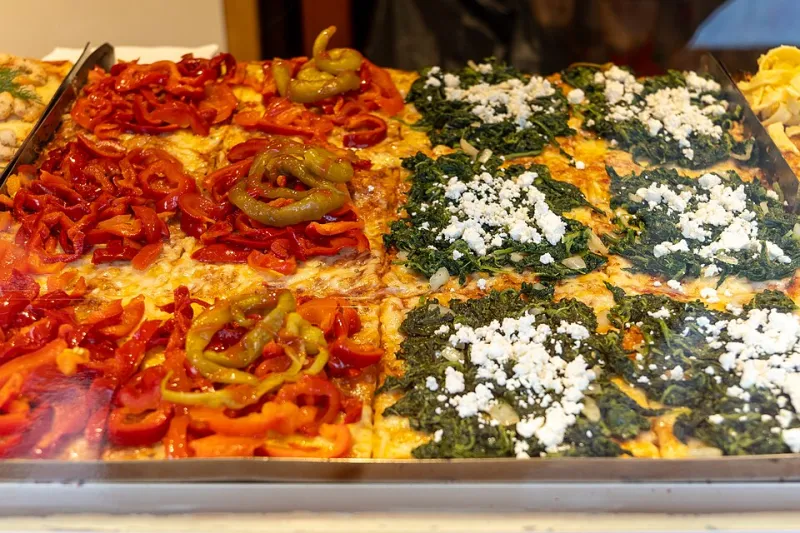
The market slice is a different animal. Softer dough, often Roman-style and baked in a big rectangular tray, sold by weight or by the square. It's slower, friendlier, and frequently better than the stuff being sold for twice the price two streets away.
The queue is part of the experience here, and genuinely so. Half the pleasure is standing in a covered market in Leeds, Cardiff, Newcastle or Birmingham with a paper plate, listening to two traders argue about a delivery, and eating something that has clearly been made by the same person who just handed it to you.
Judgement call: tray pizza goes stale at the edges as the afternoon wears on. Go early. A tray slice at 11.45am is a different proposition to the same slice at 3pm.
The station-side counter
This is the format's great modern triumph: the slice shop that has worked out it doesn't need tables. It needs a till, an oven, a stack of napkins and a window shelf for standing eaters, and it needs to be within four minutes' walk of a platform.
These places are judged on speed above all. If you can order, pay and be eating within ninety seconds, the rest barely matters — and honestly, a slightly under-seasoned sauce is forgivable when you've got a train in six minutes. What isn't forgivable is the reheated-to-lukewarm slice, which is the single most common failure in the whole category. Cold-in-the-middle is a betrayal at any price.
The etiquette of the paper plate
A small manifesto, since nobody else is going to write one.
- Fold, don't fight it. The fold is the whole technology of the slice. Work with it.
- Don't eat it walking down the street. Stop. Lean on something. Give it the ninety seconds it deserves.
- Napkins are for the hand, not the pizza. Blotting the top of a slice is a confession that you'd rather be eating something else.
- If there's a bin within sight, sort your plate before you leave the counter, not three streets away.
- Never order two slices on the same plate. They steam each other. It's a beginner's error and it ruins the second one.
The verdict
A sit-down pizza is a nicer evening. A slice is a better lunch. That's the trade, and it's a good trade, and Britain is now full of people getting it right.
So: find a hatch, join the queue, take the paper plate, stand on the pavement with your coat collar up and eat something that was made and baked and handed over within a few metres of where you're standing. That's not a compromise on a proper pizza night. That's a separate, excellent thing entirely.